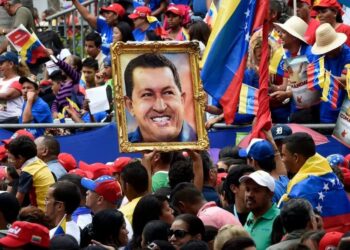
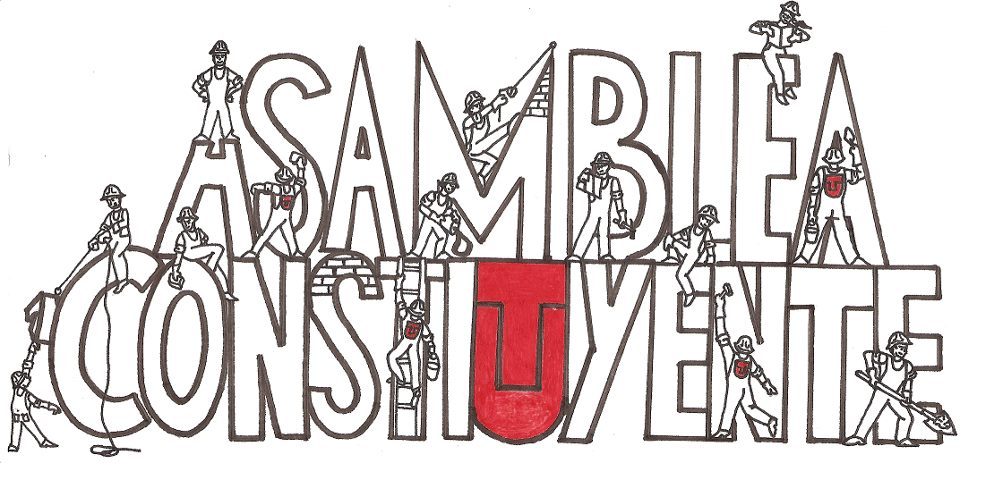
Faced with the decision of a sector of the Venezuelan opposition to abandon the space of democratic politics and take the path of violence and foreign intervention, President Nicolás Maduro took the constitutional initiative to open a new phase of the constituent process called for by Commander Chavez in 1999. This option enables an electoral path and solves the problem of the unjustifiable denial of the opposition to dialogue with the legitimate and legal government of the Republic.
The objective is to achieve a new historical triggering event, like the one taking place in 1998, when we elected Commander Chavez, allowing our people to follow the peaceful path of deep transformations our society needs and leave aside the threats of a coup d’État, a civil war or a foreign intervention.
President Maduro took the constitutional initiative to call for a new Constituent Assembly.
The single call of President Maduro has taken over the national political agenda and has isolated violent people. In the heat of the debate, the first questions have arisen and I will try to answer them in this article:
- What is the Constituent Power?
French thinker Emmanuel Sieyes was the first to set up the theoretical framework of the constituent power. In 1788, just before the French revolution, he affirmed that the nation, understood as common will, is the repository of the original power from which the branches of government are constituted. This is the reason why he calls it Constituent Power.
- What is the National Constituent Assembly?
It is the juridical space where the representatives elected by the constituent power gather to agree on the social coexistence and the legal regulation that rules it: the Constitution.
- Is it established in the Constitution of the Bolivarian Republic of Venezuela?
The Bolivarian Constitution, which resulted from the constituent process led by Commander Hugo Chávez, acknowledges the people’s original power in Article 347.
- What is its purpose?
The transformation of the state, the creation of a new juridical order, and the drafting of a new constitution.
- Why is it called at this moment?
In order to promote a great national dialogue to stop the escalation of violence promoted by the opposition leadership, preserve the independence and peace of the Republic and set up the constitutional foundation of a social model, where we can all live under an atmosphere of mutual recognition, equality, justice, peace and dignity.
The single call of President Maduro has taken over the national political agenda and isolated violent people.
- Can the President of the Republic call for a National Constituent Assembly?
Article 348 of the 1999 Constitution establishes that the President of the Republic, the National Assembly, the Town Councils or the citizens can take the initiative to call for it. In this case, President Nicolás Maduro took the initiative.
- How are its members elected?
By universal, secret and direct vote.
- Why does President Maduro propose a territorial and a sectorial election process?
Since the 1999 Bolivarian Constitution acknowledges the multiethnic and multicultural nature of our society, and establishes the participatory and protagonist role of social sectors in the exercise of democracy, an electoral process by social sectors and by territory are both deemed pertinent.
This is why President Maduro has proposed that the main social sectors shall elect their specific representatives, as well as representatives in their territorial area. Everybody is going to vote.
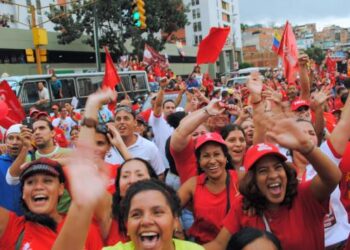
The main social sectors shall elect their representatives.
- What is the criterion to select sectors?
It takes into consideration the institutional, historical, reliable and verifiable registers that ensure the principle of universality of the respective sector.
- What is the process for candidates’ nomination?
Nominations will take place on the candidates’ own initiative. They will be supported by the number of signatures established by the Electoral Power.
- Is the dual-voting system discriminatory?
No. Each person will have as many votes as posts in the circuit. The same happens in plurinominal and indigenous circuits.
- Can the elected branches of government continue to work once the National Constituent Assembly is installed?
Yes, they can. However, they can not oppose the decisions of the National Constituent Assembly, as it is established by Article 249 of the 1999 Constitution.
- Does the National Constituent Assembly draft a new Constitution?
Yes. It does it by deepening and widening the doctrinaire foundations of Independence, Sovereignty, Participatory and Protagonist Democracy, pluriculturalism, mixed economy and social equality enshrined in our Constitution.
The Constituent Assembly will take place for the peace and future of our youth.
- What issues will be discussed in the National Constituent Assembly?
The National Constituent Assembly will set its agenda for discussion based on the national priorities. However, as the convener, the President has proposed nine programmatic lines for the constituent debate: Peace as a need, right and yearning of the nation; the improvement of the national economic system to turn Venezuela into a power; giving constitutional status to Missions and Great Socialist Missions; widening power of the Justice System in order to eradicate impunity of crimes; giving constitutional status to new forms of participatory and protagonist democracy; the defense of sovereignty, the integrity of the nation and the protection against foreign interventionism; the recognition of the multicultural nature of the Homeland; the guarantee for the future and our youth through the inclusion of a constitutional chapter to enshrine youth rights and the preservation of life on the planet.
Upholding the purest Bolivarian tradition of summoning the people’s sovereignty to clear the horizon of the Homeland, we are going through a Constituent process for the peace and future of our youth. May God and the people be with us.
Published on May 6th, 2017